Not all shop shelving is created equal. The right system should suit your products, maximise your available space and support the way your business operates, not just look good or come with the lowest price tag.
This guide explains what to look for before buying shop shelving, helping you compare options confidently and avoid costly mistakes.
Before looking at shelving designs or requesting quotes, take a step back and think about how your store operates. The best shelving for a supermarket, boutique, hardware store or convenience shop can be very different because the products, customer behaviour and stock levels are different.
Start by considering:
For example, a gift shop displaying lightweight products has very different shelving requirements from a pet store carrying large bags of food or a bottle shop storing heavy cartons.
Planning these details first makes it much easier to choose shelving that performs well day after day, rather than simply looking good on opening day.
There isn’t one shelving system that suits every retailer. Each type serves a different purpose, and many stores use a combination of shelving styles throughout the shop.
| Shelving type | Best suited for |
| Single-sided wall shelving | Maximising display space along perimeter walls |
| Double-sided gondola shelving | Creating central aisles and displaying high volumes of products |
| End bays | Promotions, seasonal products and impulse purchases |
| Pegboard shelving | Hanging accessories, tools and small packaged items |
| Wire shelving | Cool rooms, food storage and areas requiring better airflow |
“The best shelving system is the one that fits the way the store operates, not simply the one with the lowest price tag. We always encourage retailers to think about how they’ll replenish stock, expand product ranges and use the space over the next five to ten years—not just on opening day.”
Neil Webster, CEO of Mills Shelving
Double-sided gondola shelving remains one of the most popular choices because it makes efficient use of floor space while allowing customers to browse products from both sides. Wall shelving complements this by maximising the available perimeter of the store.
The right combination depends on your product range, available space and how you want customers to move through the shop.
If you’re unsure which configuration best suits your business, our shelves for shops solutions are designed around your store layout, product mix and merchandising goals rather than offering a one-size-fits-all approach.
The overall dimensions of your shelving have a direct impact on both customer experience and store efficiency. Bigger isn’t always better, and neither is fitting as many shelves as possible into the available space.
Taller shelving increases display capacity, making it ideal for perimeter walls where maximising storage is often the priority.
Lower shelving works particularly well through the centre of a shop because it improves visibility across the store, creates a more open feel and allows staff to monitor customers more easily.
Shelf depth should match the size of the products being displayed.
Shallow shelves often suit pharmacies, cosmetics and gift stores where products have a small footprint. Deeper shelves are generally more suitable for groceries, beverages, hardware and larger packaged goods.
Choosing shelves that are deeper than necessary may reduce aisle space and make products harder to reach. Shelves that are too shallow can leave products overhanging the front edge or limit the amount of stock you can display.
The width of each shelving bay influences both flexibility and appearance.
Narrower bays can make it easier to work around columns, corners and irregular wall lengths. Wider bays create longer product runs with fewer interruptions, producing a cleaner overall presentation.
Rather than selecting dimensions individually, it’s better to consider how the entire shelving system will fit your store and support customer movement.
One of the biggest mistakes retailers make is assuming every shelf can safely hold the same amount of weight.
Load capacity depends on several factors, including the shelf dimensions, bracket configuration and overall shelving system. A shelf carrying confectionery has very different requirements from one displaying paint tins, bottled drinks or large pet food bags.
As a general rule:
Choosing shelving with adequate capacity provides greater flexibility as your product range evolves and reduces the risk of premature wear or damage.
If you’re unsure what capacity you require, discuss your products with your shelving supplier rather than relying on a generic weight rating.
Even high-quality shelving won’t perform well if the overall layout makes shopping difficult.
Good store layouts encourage customers to browse naturally while making it easy for staff to replenish products throughout the day.
When planning your shelving, think about:
It’s also worth thinking about future changes. Seasonal promotions, new product ranges or expanding departments are much easier to accommodate when the initial layout has been planned carefully.
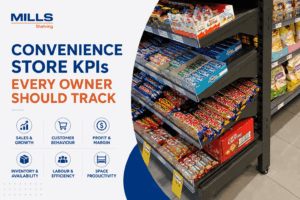
For convenience stores, tracking convenience store KPIs such as category performance, sales per square metre and inventory turnover can also help identify which areas deserve more shelf space and where the layout may need adjusting.
A well-designed shelving layout doesn’t just improve presentation—it also supports smoother day-to-day operations.
Retail businesses rarely stay the same.
Product ranges expand, departments move, customer preferences change, and stores often need refreshing over time. If you’re deciding between new vs used shelves for shops, it’s also worth considering how easily the shelving can be expanded or reconfigured over time. Choosing a modular shelving system makes these changes much easier and more cost-effective.
A modular system allows you to:
This flexibility is one of the biggest advantages of commercial shelving compared with fixed display units.
Although modular systems may sometimes require a slightly higher initial investment, they often reduce long-term costs by extending the usable life of your store fit-out.
The advertised starting price of a shelving bay rarely reflects the total cost of fitting out a shop.
Before comparing quotes, make sure you’re comparing the complete package rather than the base shelving alone.
A quotation may include:
Some suppliers include many of these items as standard, while others price them separately.
For this reason, the lowest quote isn’t necessarily the lowest project cost.
The advertised starting price of a shelving bay rarely reflects the total cost of fitting out a shop.
Additional shelves, accessories, freight and installation can all have a significant impact on your final budget, which is why understanding how much shelves for shops cost in Australia involves looking beyond the base price alone.
The shelving itself is only part of the purchase. The supplier also plays an important role in the success of your project.
When comparing suppliers, look beyond price and consider the level of support you’ll receive before, during and after installation. If you’re still researching where to buy shelves for shops in Australia, it’s worth comparing suppliers based on product quality, stock availability, installation support and ongoing access to replacement parts, not just the initial quote.
A good supplier should offer:
Choosing an experienced supplier can also help avoid common issues such as ordering the wrong shelving configuration, underestimating the number of bays required or overlooking important accessories.
At Mills Shelving, we work with retailers across Australia to recommend shelving systems that suit their products, available space and future plans, helping businesses invest in solutions that continue to perform for years rather than simply meeting immediate requirements.
Before requesting quotations, make sure you’ve covered these essentials.
✓ Identified the products you’ll be displaying
✓ Considered product weight and shelf load requirements
✓ Chosen the most suitable shelving type
✓ Planned your store layout and customer flow
✓ Selected appropriate shelf dimensions
✓ Allowed for future business growth
✓ Compared complete quotations rather than starting prices
✓ Checked what’s included with installation and accessories
✓ Reviewed warranty and replacement part availability
✓ Chosen a supplier with proven commercial experience
Completing this checklist will help you compare shelving solutions with greater confidence and reduce the likelihood of costly changes after installation.
Every retail business has different products, layouts and merchandising goals, so the best shelving solution is rarely the same from one store to the next.
At Mills Shelving, we help retailers across Australia choose shelving systems that maximise space, support efficient day-to-day operations and remain flexible as their business grows.
Whether you’re fitting out a new store or replacing existing shelving, our team can recommend a solution tailored to your requirements.