Supermarkets are one of the few retail environments where physical layout still dictates performance at scale. Every aisle, every shelf height, and every product position influences how shoppers move, what they notice, and ultimately what they buy.
That influence is not marginal. It is measurable.
Consumer behaviour has shifted in recent years, with shoppers becoming more deliberate in how they spend. Purchases are more intentional, and value perception plays a larger role in decision-making. In that environment, shelving is no longer just about storage or display. It is a core driver of revenue.
Supermarkets operate at a level of foot traffic that few retail formats can match. In 2024 alone, grocery stores recorded approximately 17.2 billion visits, highlighting how frequently consumers interact with these spaces.
That volume matters, but time spent in-store matters more.
On average, shoppers spend around 23.4 minutes inside a supermarket. That window is where all purchasing decisions happen. It defines how much exposure products receive and how effectively a store converts traffic into sales.
From a layout perspective, those 23 minutes are not evenly distributed. Movement patterns tend to cluster around high-traffic zones such as entrances, fresh food sections, and checkout areas. Aisle design, shelf positioning, and product placement all determine how shoppers navigate these spaces.
Retailers that understand this dynamic treat layout as a system, not a static design. The relationship between traffic flow and product exposure is explored further in broader retail environments, as outlined in these retail store layout statistics.
For supermarkets, the principle is the same, but the stakes are higher due to frequency and basket size.
Once inside the store, most purchasing decisions are not pre-planned. They are influenced in real time.
Up to 70% of purchase decisions are made in-store, meaning the majority of buying behaviour is shaped by what shoppers see, where they see it, and how it is presented.
That process happens quickly.
Shoppers typically make decisions in less than six seconds when evaluating products on the shelf. That leaves very little room for poor placement or low visibility. If a product is not immediately noticeable, it is unlikely to be chosen.
Promotions further amplify this behaviour. In supermarkets, pricing and promotional placement do more than drive planned purchases. They actively create new ones. Strategic placement of discounted or featured items increases unplanned purchases and expands basket size beyond the shopper’s original intent (Source: https://www.accc.gov.au/system/files/sib-expert-report-behavioural-insights-report.pdf).
A pattern emerges when this behaviour is viewed at the store level:
That pattern also explains why the first store in a shopping trip often captures the largest share of spend. Around three-quarters of shoppers still visit multiple supermarkets, but larger baskets are typically built in the first store, reducing spend in subsequent visits.
For operators, that means early exposure matters. Entrance zones, high-traffic aisles, and front-of-store displays carry disproportionate influence.
If in-store decisions are made quickly, then shelf placement becomes the deciding factor.
The data is clear. Position directly affects revenue.
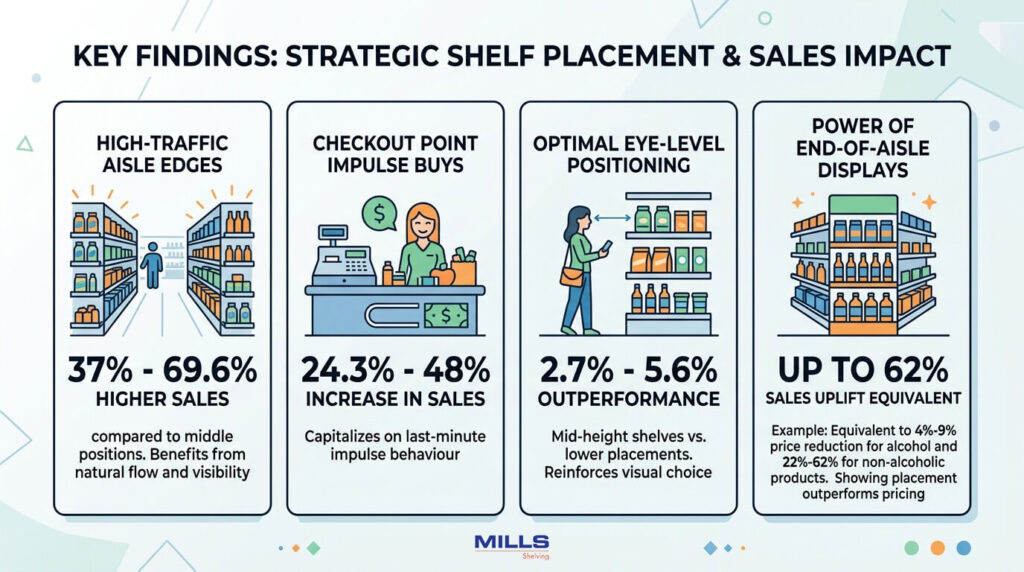
Products placed at aisle edges generate between 37% and 69.6% higher sales compared to those positioned in the middle of shelves. These areas benefit from natural traffic flow and higher visibility.
Checkout zones perform even more aggressively. Products positioned near checkouts see a 24.3% to 48% increase in sales, driven by impulse behaviour in the final stage of the shopping journey.
Even smaller adjustments have a measurable impact.
Mid-height shelves outperform lower placements by 2.7% to 5.6%, reinforcing the importance of eye-level positioning in influencing choice.
These gains compound when applied across an entire store.
End-of-aisle displays, often used for promotions or high-margin products, deliver some of the strongest results. In some cases, the uplift is equivalent to a 4% to 9% price reduction for alcohol and 22% to 62% for non-alcoholic products.
That comparison is important. It shows that placement alone can outperform pricing strategies.
From a practical standpoint, this is where planning becomes critical. Allocating shelf space without considering performance differences leads to lost revenue. Tools such as a retail shelf space calculator can help retailers model how much space should be assigned to different categories and products based on expected return. Retailers also need to understand how shelving configuration, layout size, and fixture selection affect overall setup costs, especially when planning new store fit-outs or upgrades. Many operators also spend time researching how to choose the right supermarket shelving supplier before committing to larger rollout decisions. Our guide on supermarket shelving costs breaks down the major pricing factors involved.
Mills Shelving works with supermarket operators on this exact challenge. The goal is not to maximise shelf capacity, but to maximise sales per metre of shelving.
Because in supermarkets, space is not neutral. Every section of shelving carries a different revenue potential.
A strong shelf placement strategy only delivers results if it is executed consistently. In practice, that is where many supermarkets fall short.
Only around 70% of products specified in planograms are actually implemented correctly in-store, and in many cases, compliance drops below 50%. That gap represents lost visibility, missed promotions, and ultimately, lost revenue.
Poor execution shows up in simple ways:
Each of these issues disrupts the intended shopper journey.
The impact of fixing this is immediate. Improving planogram compliance can drive a 7.8% increase in sales and an 8.1% uplift in profit within a short period.
That level of uplift does not come from redesigning the store. It comes from executing what is already planned.
From a merchandising perspective, consistency matters as much as strategy. Even high-performing layouts lose effectiveness when shelves are not maintained, refilled, or aligned with planograms.
This is where execution frameworks and in-store discipline play a role. For teams looking to refine how products are presented and maintained, these visual merchandising tips provide practical guidance on improving shelf presentation and shopper engagement.
Not all categories behave the same on the shelf. Some drive planned purchases, while others rely heavily on visibility and in-store influence.
Fresh food sits at the centre of supermarket strategy, with broader grocery store statistics also showing how product mix, store investment and changing shopper behaviour continue to shape the sector.
Nearly 90% of consumers say fresh food makes them happy, and 66% are willing to pay a premium for it. That makes fresh categories not only high-traffic areas, but also high-value ones.
Retailers recognise this. More than half of grocery operators expect fresh departments, including produce, deli, and meat, to be their most strategically important areas over the next few years.
Placement within these categories directly affects performance.
Impulse behaviour is especially strong here. Around 90% of shoppers purchase produce items they did not originally plan to buy, and 48% do so frequently, driven by in-store displays and product exposure.
This changes how shelves should be approached.
Fresh food shelving is not just about storage or accessibility. It is about:
The same principle applies across other high-margin categories. Products that rely on impulse, such as snacks, beverages, and convenience items, benefit from placement in high-traffic zones and near checkout areas.
In supermarkets, category performance is closely tied to where products are placed, not just what is stocked.
When these data points are combined, a clear pattern emerges. Shelf strategy is not just about increasing sales. It is about protecting margins and improving operational efficiency.
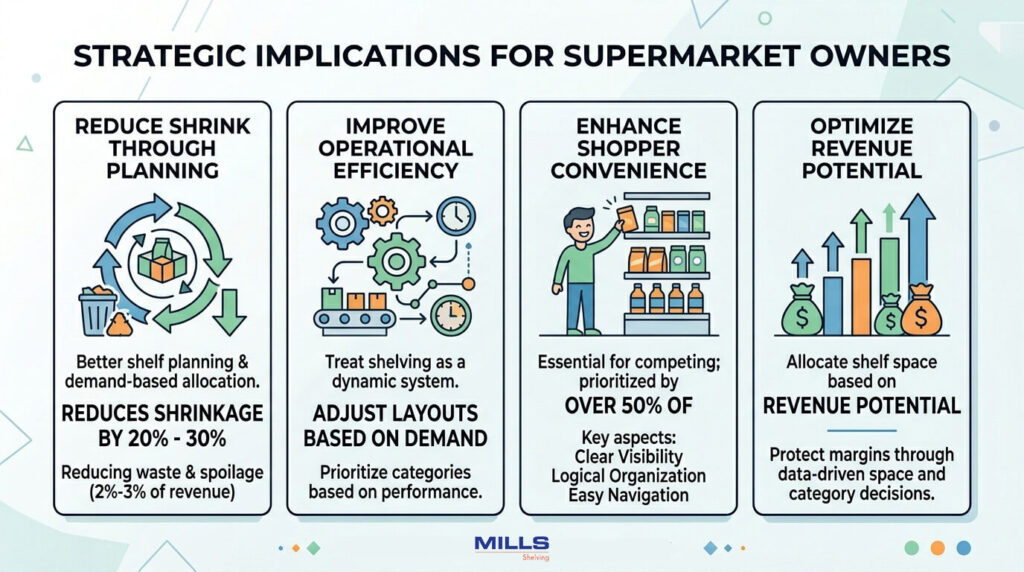
Shrink remains one of the biggest challenges in grocery retail. Waste and spoilage typically account for 2% to 3% of revenue, rising to 5% to 15% in ready-to-eat categories.
That loss is not only a supply chain issue. It is also a shelving and layout issue.
Better shelf planning and demand-based allocation can reduce shrinkage by 20% to 30% through improved forecasting and product rotation. Even short-term adjustments to shelf space and placement can reduce shrink by 5% to 15% while improving product presentation.
At the same time, shopper expectations are shifting.
More than half of shoppers now prioritise convenience more than they did previously, and over 80% of industry participants agree that competing on convenience is essential for increasing sales.
Convenience in supermarkets is not just about speed. It is shaped by:
Poor shelving disrupts all three.
From an operational standpoint, high-performing supermarkets treat shelving as a dynamic system. Layouts are adjusted based on demand, categories are prioritised based on performance, and shelf space is allocated based on revenue potential rather than equal distribution.
This is where purpose-built shelving systems play a role. For supermarkets looking to align layout, merchandising, and operational efficiency, structured solutions like supermarket shelving systems provide the foundation for consistent execution.
The data across supermarket retail is consistent. Shopper behaviour is influenced in-store. Shelf placement changes outcomes. Execution determines results.
What separates average stores from high-performing ones is not access to information. It is how that information is applied.
Each element builds on the next.
Supermarkets that treat shelving as a strategic asset, rather than a static fixture, are better positioned to increase basket size, improve category performance, and reduce operational losses.
The advantage does not come from doing more. It comes from placing the right products in the right locations at the right time.
Over time, those decisions compound.
Translating these insights into real-world results requires more than theory. It comes down to having the right shelving systems in place, built to support high-traffic environments, frequent restocking, and constant layout adjustments.
Mills Shelving works closely with supermarket operators to design shelving solutions that align with how shoppers actually move, browse, and buy, not just how stores are traditionally set up.
Every decision, from gondola configuration to shelf height and spacing, is approached with performance in mind.
The goal is simple: increase visibility, improve product flow, and maximise sales per metre.
For supermarkets looking to apply these data-driven strategies at scale, Mills Shelving provides the structure that turns layout into measurable growth.