Retail fit-outs are no longer driven by appearance alone.
Across Australia, store layouts are being redesigned around customer movement, fulfilment efficiency, merchandising flexibility, and operational speed. Retailers are investing more heavily in shelving systems, modular shop fittings, and store refurbishments because physical retail still plays a major role in how consumers buy.
The numbers support that shift.
Australian retail turnover increased 4.9% year-on-year in June 2025, showing continued strength across the retail sector despite ongoing economic pressure.
Consumer spending also remained strong heading into 2026. Household retail spending reached AU$38.63 billion in January 2026, increasing 5% year-on-year, with cafés, restaurants, and specialty retail categories among the strongest performers.
That matters for the shop fitting industry because growing retail spend typically flows into:
Retailers rarely expand sales capacity without investing in the physical environment supporting it.
The role of shop fitting has changed alongside that shift. Modern retail fit-outs now need to balance visual merchandising, customer experience, fulfilment logistics, stock accessibility, and flexibility for future category changes.
For many retailers, shelving systems have become operational infrastructure rather than simple store fixtures.
That is one reason demand for specialised retail fit-out providers continues growing across Australia. Businesses increasingly want integrated supply and installation support rather than managing multiple contractors separately. Our retail shop fitting service reflects that broader market trend, particularly among retailers looking for faster rollout timelines and simplified project management.
The broader fit-out sector is growing steadily, supported by commercial construction activity, retail reinvestment, and increasing demand for modernised store environments.
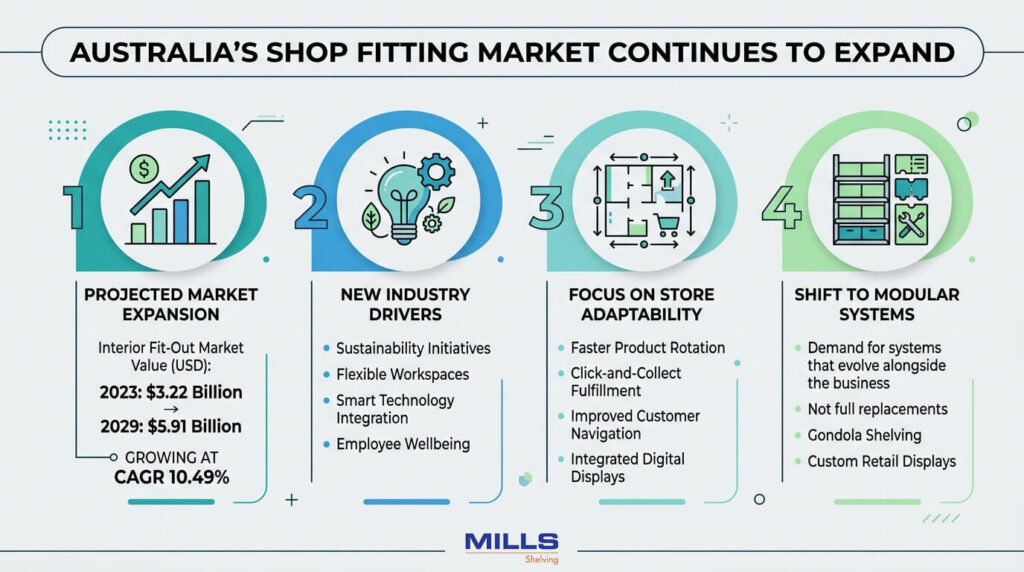
Australia’s interior fit-out market was valued at approximately US$3.22 billion in 2023 and is projected to reach US$5.91 billion by 2029, growing at a CAGR of 10.49%. These forecasts continue shaping discussions around the broader shopfitting industry Australia market size and long-term retail infrastructure demand.
That growth rate is significant.
It indicates that retailers, commercial property owners, and developers are continuing to invest heavily in physical spaces despite ongoing growth in eCommerce. Physical retail remains commercially valuable when stores are designed properly.
The drivers behind that investment are also changing.
According to TechSci Research, sustainability initiatives, flexible workspaces, smart technology integration, and employee wellbeing are now major forces shaping Australia’s fit-out industry.
Retailers are redesigning stores around adaptability.
Layouts now need to support:
Static store layouts are becoming less viable in high-turnover retail categories.
A second market forecast from Credence Research projects Australia’s interior fit-out market will grow from US$445.92 million in 2023 to US$819.89 million by 2032.
While market sizing methodologies vary between research firms, both reports point in the same direction: commercial fit-out activity is expanding, not contracting.
The strongest activity continues to sit within Sydney, Melbourne, and Brisbane due to their concentration of shopping centres, retail developments, and commercial infrastructure projects.
That concentration creates ongoing demand for:
Retailers increasingly want systems that can evolve alongside the business rather than requiring full replacements every few years. That is one reason modular shop fittings continue gaining traction across supermarkets, convenience stores, pharmacies, hardware retailers, and specialty retail environments.
Store openings remain one of the clearest indicators of future shop fitting demand.
Large retailers continue expanding aggressively across Australia, while also reinvesting into refurbishment programs to modernise older locations.
Woolworths opened six net new supermarkets and completed 68 store renewals during FY2025.
That renewal number is particularly important.
Refurbishments now represent a major portion of fit-out industry activity because many retailers are prioritising upgrades over entirely new developments. Existing stores often require:
Woolworths also expanded its “Mini Woollies” convenience format to 100 stores nationwide.
Smaller-format retail is becoming increasingly common in high-density urban areas where retailers need compact layouts with higher merchandising efficiency per square metre.
That creates demand for more flexible shelving systems capable of supporting tighter store footprints without reducing display capacity.
Coles followed a similar trajectory.
The retailer completed 60 supermarket renewals during FY2025 while expanding its supermarket network to 860 locations nationally.
Its liquor division also completed 118 store renewals during the same period.
Liquor retailing has become particularly competitive from a merchandising perspective. Product visibility, promotional positioning, aisle navigation, and category organisation now heavily influence purchasing behaviour inside the store.
JB Hi-Fi also announced plans to open five new Australian stores during FY2026.
Meanwhile, Super Retail Group opened 31 new stores during FY2025 across brands including Supercheap Auto, Rebel, BCF, and Macpac.
Collectively, these expansion programs create substantial downstream demand for:
This question is becoming more common as retail fit-out demand continues increasing across supermarkets, hospitality, pharmacies, and specialty retail sectors.
Industry directories now list more than 100 active Australian shopfitting manufacturers and fit-out providers offering services such as retail shelving installation, custom joinery, store fit-outs, and project management.
The Interior Fitout Association (IFA) also states that its members include shop and office fitters, manufacturers, suppliers, subcontractors, and service providers operating across the Australian fit-out industry.
The scale matters.
Every store rollout involves multiple infrastructure layers, from shelving and display systems through to stockroom integration and customer movement planning.
Many retailers are also shifting toward staged fit-out strategies rather than full rebuilds. Instead of replacing entire store environments, businesses are selectively upgrading shelving, merchandising zones, and high-traffic display areas to reduce costs while still modernising the customer experience.
That approach is becoming increasingly important as fit-out costs continue rising across Australia. A growing number of retailers are comparing complete fit-outs against shelving-focused upgrades to improve ROI and reduce operational disruption. This shift is explored further in our breakdown of retail fit-out costs vs shelving-only fit-outs.
The shop fitting industry does not operate independently from broader construction conditions. Much of the data highlighted throughout this shop fitting contractors Australia industry report is directly influenced by retail development activity, commercial approvals, and infrastructure investment trends.
Retail fit-outs sit downstream from commercial development activity, leasing demand, approvals, and infrastructure investment.
Non-residential building work done in Australia rose 0.3% to AU$17.0 billion during the December 2025 quarter and was 7.9% higher year-on-year.
That increase signals continued strength across commercial construction categories connected to retail development, shopping centres, hospitality venues, and mixed-use precincts.
The broader pipeline remains substantial.
Australia’s public infrastructure pipeline exceeded AU$242 billion heading into 2026.
Large-scale infrastructure spending places additional pressure on labour availability, subcontractor capacity, freight logistics, and material supply chains across the entire construction ecosystem, including retail fit-outs.
At the same time, there are signs of moderation ahead.
The value of non-residential building approvals fell 25.3% to AU$5.97 billion in March 2026.
Approval data often acts as a leading indicator for future construction activity. A slowdown in approvals can eventually reduce future fit-out pipelines if fewer retail and commercial projects commence.
The longer-term outlook remains positive despite short-term fluctuations.
Forecasts suggest non-residential construction activity between 2025/26 and 2029/30 will still be 13.4% higher than the previous five-year period.
That indicates sustained long-term demand for commercial interiors, retail infrastructure, and shop fitting services even as construction conditions become more volatile.
The shop fitting industry is no longer being driven purely by new store construction.
Refurbishments now represent one of the largest segments of retail fit-out activity across Australia.
Retailers are updating stores more frequently because customer expectations have changed. Layouts that worked five years ago often struggle to support modern merchandising strategies, fulfilment workflows, and omnichannel retail operations.
Those sectors typically require:
Retail property conditions also strengthened considerably during 2025, with retail property total returns reaching 7.3% in the September 2025 quarter.
Improving retail property performance generally leads to increased reinvestment into physical stores. Landlords and retailers both become more willing to fund upgrades when occupancy remains strong and leasing demand improves.
The structure of refurbishment projects is changing as well.
Many retailers are no longer approaching fit-outs as complete demolition-and-rebuild exercises. Instead, businesses are selectively upgrading:
That approach reduces downtime while still modernising the customer experience.
For retailers operating multiple locations, partial upgrades also allow rollout programs to scale faster across entire store networks without the disruption and cost of full rebuilds.
Retail shelving used to be treated as a static fixture.
That is no longer the case.
Modern retailers now view shelving systems as operational infrastructure directly tied to sales performance, inventory efficiency, and customer experience.
This shift is becoming more visible across supermarkets, hardware stores, pharmacies, convenience stores, and specialty retail environments where layouts need to change regularly around seasonal promotions, supplier agreements, and category performance.
Boston Consulting Group noted that retailers are increasingly treating stores as part of a broader retail ecosystem rather than standalone locations. Stores are now functioning simultaneously as:
That fundamentally changes how retailers approach store planning.
Shelving systems now need to support operational flexibility rather than simply maximising product capacity. Retailers increasingly want layouts that can adapt quickly without requiring full store shutdowns or expensive rebuilds.
This is one reason modular gondola shelving continues growing across Australian retail environments. Businesses want systems that can evolve alongside category changes, promotional activity, and customer behaviour shifts.
At Mills Shelving, this trend is particularly noticeable among multi-location retailers. Many businesses now prioritise:
The operational side of shelving decisions is becoming far more important than aesthetics alone.
BCG also found that automation and AI tools can reduce retail labour costs by 5–10% while saving employees around 25% of time spent on manual in-store tasks such as inventory checks and price updates.
That matters because physical store infrastructure increasingly needs to support operational automation.
Retailers are redesigning layouts around:
The role of merchandising infrastructure is becoming increasingly operational rather than purely visual.
The economics of retail fit-outs have changed significantly over the past few years.
Construction cost escalation across Australia is forecast to remain between 4% and 6% throughout 2026, depending on city and project type.
Fit-out costs continue rising due to labour shortages, supply chain disruptions, and increasing compliance requirements.
These pressures affect nearly every stage of a retail fit-out project:
The labour situation remains particularly difficult.
Industry groups continue warning that labour shortages are one of the biggest constraints across Australia’s construction and fit-out sectors.
That shortage affects retailers directly through:
The cost structure of modern fit-outs also surprises many retailers.
According to JLL, builder’s works account for approximately 41% of total fit-out costs in Australia, while furniture, fixtures, and equipment account for roughly 23%.
That means shelving systems, displays, and merchandising infrastructure now represent a major financial component of retail development projects.
Retailers are responding by becoming more selective about where they allocate fit-out budgets.
Instead of rebuilding entire stores, many businesses are investing more heavily into:
The broader construction sector continues facing similar pressure.
McKinsey reported that supply-chain disruptions, labour shortages, and raw-material price volatility are still affecting the global building materials and construction sector.
These conditions are now flowing directly into Australian retail fit-outs through material pricing, freight delays, and installation scheduling challenges.
Retail shopfitting logistics has become a major operational challenge for large store rollouts and refurbishment projects.
Many fit-out projects now depend on materials arriving from multiple suppliers and countries. Delays involving shelving, signage, displays, joinery, or fixtures can quickly impact installation schedules and store opening timelines.
WT Partnership also reported that labour shortages, supplier pressure, and specialist trade availability continue affecting commercial fit-out delivery across Australia. The report noted that fit-out contractors are still dealing with pricing pressure, lead time challenges, and subcontractor shortages.
Retail technology adoption is now influencing physical store design at a much faster pace.
47% of Australian retailers believe AI is now core to their business operations.
That shift extends well beyond online retail.
Physical stores increasingly need to support:
Store infrastructure is becoming more connected.
AI adoption, BIM systems, and digital project controls are also becoming increasingly standard across commercial and retail construction projects throughout Australia.
Retailers now expect fit-out providers to support more technically integrated environments from the beginning of the planning process.
The sustainability side of fit-outs is also accelerating.
JLL reported that 72% of cost management leaders saw increased demand for sustainable fit-outs and environmentally focused commercial interiors.
That demand is influencing:
Retailers increasingly want fit-out systems that can be reconfigured rather than discarded during future upgrades.
This shift aligns strongly with modular shelving systems because they allow stores to evolve without requiring complete infrastructure replacement every few years.
The Australian shop-fitting industry is moving into a different phase of growth.
Demand is no longer tied purely to new retail developments. A large portion of future growth will come from:
Physical retail is still expanding.
NielsenIQ found that average consumer spending per shopping trip increased 4% year-on-year while shopping frequency also rose heading into 2026.
Consumers are still actively shopping in-store. Retailers are simply becoming more strategic about how those environments are designed and operated.
That changes the role of shop-fitting businesses.
Retailers increasingly expect fit-out providers to contribute operational value, not just installation capability. Layout efficiency, flexibility, scalability, merchandising logic, and long-term durability are becoming far more commercially important.
The businesses positioned strongest over the next few years will likely be those capable of delivering:
The industry itself is becoming more sophisticated.
Retail fit-outs are no longer just construction projects. They are increasingly tied to sales performance, fulfilment efficiency, customer experience, and operational scalability.
We supply and install shelving systems for retailers across Australia. Many businesses now need faster store rollouts, easier refurbishments, and shelving layouts that can be reconfigured without replacing the entire setup.
Our retail shop fitting service helps retailers manage both shelving supply and installation through a single provider.
We are also seeing stronger demand for modular shelving systems that support changing layouts, promotional displays, and long-term daily use. Retailers want shelving that is durable, scalable, and easy to expand as stores evolve. That is why many businesses continue investing in flexible shop fittings rather than fixed store infrastructure that becomes harder to update over time.