Retail is not shrinking; it is being restructured. While digital continues to grow, physical stores remain the dominant revenue driver, with around 80% of retail transactions still happening in-store. This creates a direct dependency on how stores are designed, fitted, and optimised.
Gondola shelving sits at the centre of this system. It is not just a fixture choice; it is a core driver of how products are displayed, how customers move, and how efficiently space is monetised. This article breaks down the market data, usage patterns, and performance impact of gondola shelving in retail environments.
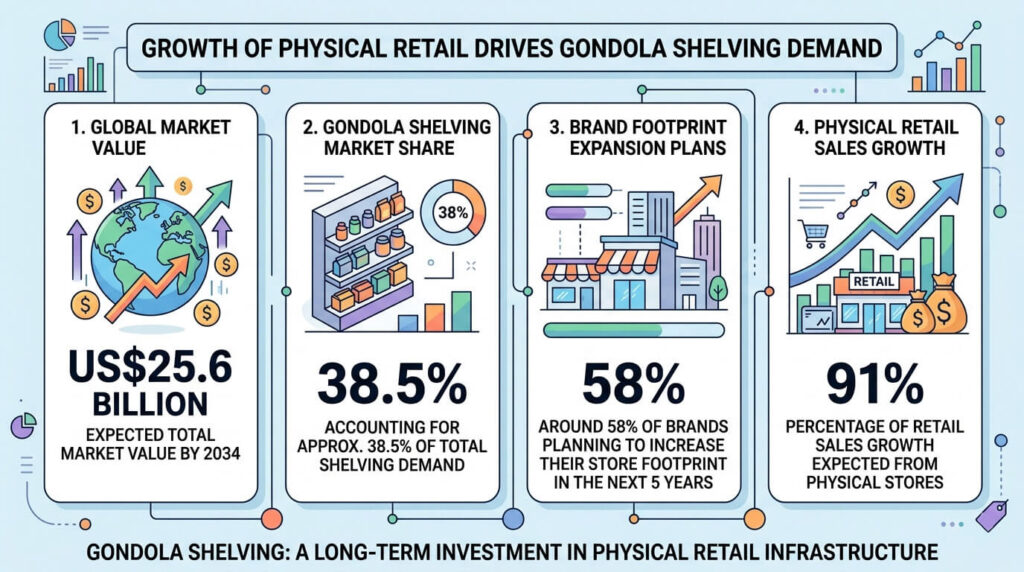
The demand for gondola shelving is directly tied to the scale and growth of physical retail infrastructure. The broader gondola shelving market continues to expand alongside retail investment, store refurbishments, and merchandising optimisation initiatives. Globally, the retail shelving market is expanding rapidly, with total market value expected to reach US$25.6 billion by 2034, reflecting long-term investment in store infrastructure and merchandising systems.
Within this, gondola shelving dominates as a core system, accounting for approximately 38.5% of total shelving demand, making it the most widely used shelving format in physical retail. Current projections also indicate continued growth in the gondola shelving market size, driven by retail refurbishment activity, store modernisation programs, and ongoing demand for more flexible merchandising systems. The gondola shelving units market remains a major segment within the broader retail fixtures industry due to its flexibility, scalability, and widespread adoption across multiple store formats.
At the same time, physical retail expansion continues. Around 58% of brands are planning to increase their store footprint over the next five years, reinforcing the ongoing need for scalable shelving systems. More importantly, 91% of retail sales growth is expected to come from businesses with a physical store presence, not pure eCommerce models.
This combination of growth and reliance on physical environments positions gondola shelving as a long-term infrastructure investment rather than a short-term fit-out decision.
While demand for physical retail is growing, space is becoming more constrained. Australia, for example, has only 0.9 square metres of retail space per person, significantly lower than the United States, which increases the pressure on retailers to maximise every metre of store space.
New retail supply is also tightening. Retail floor space development is expected to decline significantly over the coming years, forcing retailers to optimise existing stores rather than rely on expansion.
As a result, refurbishment and optimisation are becoming the dominant strategy. Around 10% of shopping centres are currently undergoing extensions or upgrades, with another 20% planning future redevelopment.
This shift directly increases demand for modular, flexible shelving systems. Supporting this trend, recent gondola shelving production insights highlight growing investment in shelving systems that can be reconfigured quickly as store layouts and merchandising strategies evolve. Retailers are no longer building new stores at scale; they are reworking existing layouts, where systems like gondola shelving play a central role in reconfiguring space quickly and efficiently.
Gondola shelving is widely adopted across multiple retail formats due to its modular structure and adaptability. This widespread adoption is one reason gondola shelves markets continue to expand across a diverse range of retail environments, from small-format convenience stores to large-scale supermarket chains.
In supermarkets and grocery stores, it forms the backbone of aisle layouts, supporting high SKU density and structured category merchandising. In convenience stores, it allows for compact layouts with high product visibility, which is critical in smaller footprints. In discount and big-box retail, gondola systems enable rapid store rollouts and frequent reconfigurations, particularly as these formats continue aggressive expansion and refurbishment cycles.
Across all formats, the common requirement is flexibility. Retailers need shelving systems that can support changing product mixes, seasonal displays, and evolving customer behaviour. This is where modular gondola systems outperform fixed shelving solutions.
For retailers evaluating setup decisions, following a structured approach to choosing the right gondola shelving for your store layout becomes critical in aligning shelving configuration with overall store objectives, including product mix, customer flow, and long-term scalability.
Retail performance is increasingly measured by how effectively space is monetised. Sales per square metre is one of the most important metrics in physical retail, and it directly reflects shelving efficiency.
Major Australian retailers provide clear benchmarks. Coles supermarkets generate approximately $19,774 per square metre in sales, while Woolworths achieves around $19,709 per square metre. In contrast, lower-density formats like discount department stores generate significantly less, with BIG W at around $4,544 per square metre.
These differences highlight how layout, shelving density, and product presentation influence overall store productivity.
With store sizes shrinking across major retail formats, competition for shelf space is increasing, making efficient shelving layout a critical factor in maintaining or improving sales density.
The way products are arranged on shelves has a measurable impact on sales performance.
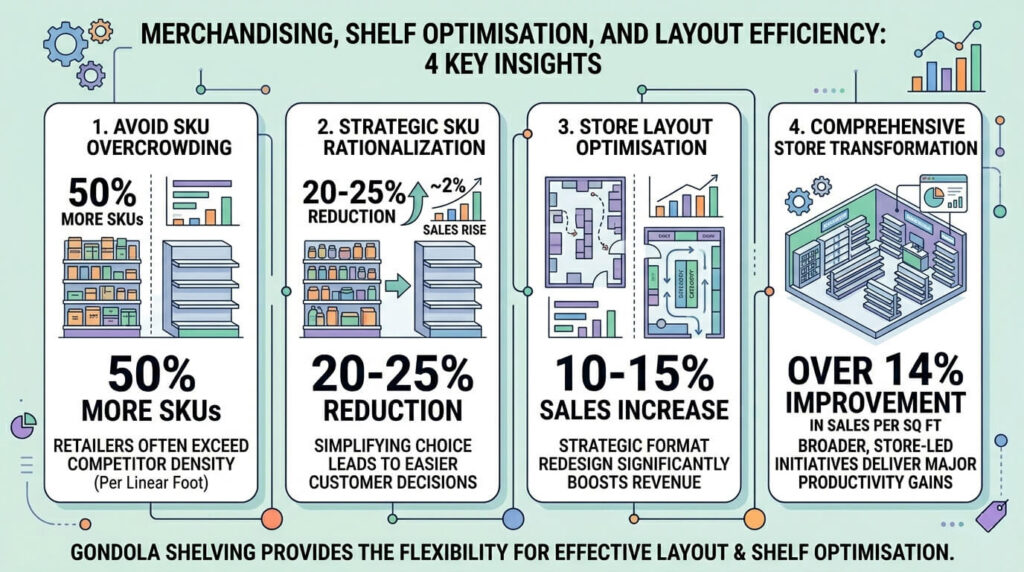
Research shows that retailers often carry 50% more SKUs per linear foot of shelf space than competitors, which increases complexity and reduces efficiency. When SKU counts are reduced by 20–25%, sales can increase by around 2% due to improved clarity and easier decision-making for customers.
At a broader level, store layout optimisation plays a significant role. Strategic redesign of store formats can increase sales by 10–15%, while more comprehensive store-led transformation initiatives have demonstrated improvements of over 14% in sales per square foot.
Gondola shelving is central to these improvements because it allows retailers to control product placement, optimise visibility, and adapt layouts without major structural changes.
Beyond layout, the effectiveness of shelving systems also depends on execution. Poor shelf availability has a direct financial impact.
Out-of-stock issues cost the retail industry approximately $48 billion annually, demonstrating how critical it is to maintain consistent on-shelf availability.
Improving inventory visibility and shelf execution can reduce lost sales by up to 45%, showing that operational efficiency at the shelf level is just as important as layout design.
This reinforces the role of gondola shelving as part of a broader system, not just a physical fixture, but a platform for inventory management, merchandising, and operational control.
Retail shelving is a major component of store investment. Recent gondola shelving production insights also highlight growing demand for durable, modular systems that can support long-term store optimisation and changing merchandising requirements. Fit-out costs in Australia typically range from A$1,500 to A$3,000 per square metre, with fixtures and shelving accounting for up to 40% of total costs.
Given this level of investment, shelving decisions need to be evaluated based on long-term performance, not just upfront cost. Retailers must consider durability, flexibility, and how well the system supports revenue generation over time.
Tools such as a dedicated gondola shelving cost calculator can help quantify these decisions, allowing retailers to align shelving investment with expected store performance, layout efficiency, and long-term return.
The data points to a clear shift in how retailers should approach store design. A detailed gondola shelf market analysis shows that retailers are increasingly prioritising space efficiency, modularity, and merchandising performance when selecting shelving systems.
Physical retail remains dominant, but space is becoming more limited. Store expansion is slowing, while refurbishment and optimisation are accelerating. At the same time, competition for shelf space is increasing, and performance is being measured more aggressively through metrics like sales per square metre.
In this environment, gondola shelving is not just a standard fixture; it is a strategic tool that enables retailers to:
For retailers planning growth or optimisation, aligning shelving systems with broader store strategy is no longer optional. It is a core component of long-term retail performance.
For retailers planning layout upgrades or store expansions, reviewing our retail shelving solutions across different store types helps clarify how shelving systems are applied in real-world environments and how they support day-to-day operations.
Gondola shelving is not used in isolation. It is integrated into the operational flow of stores, influencing how customers navigate, how products are grouped, and how frequently layouts are updated.
In supermarkets, gondola shelving supports long aisle structures designed for high-volume SKU display and category segmentation. This allows retailers to manage thousands of products while maintaining logical product grouping and consistent shopper flow. In convenience stores, where space is limited, gondola systems are configured for tighter layouts with higher product turnover, prioritising accessibility and visibility.
Discount retailers and large-format stores rely heavily on gondola shelving for rapid deployment and scalability. These retailers often execute large numbers of store rollouts and refurbishments annually, which requires shelving systems that can be installed quickly, reconfigured easily, and maintained at scale.
Across all formats, the consistent factor is modularity. Gondola shelving allows retailers to adjust shelf heights, add accessories, and reconfigure bays without replacing entire systems. This makes it a long-term solution aligned with how retail environments evolve.
Store layout is not just about space; it directly influences how customers move and what they buy.
With physical stores still accounting for the majority of transactions, the in-store experience becomes a critical driver of revenue. Gondola shelving plays a central role in shaping that experience by guiding customer flow through structured aisles and controlled sightlines.
Effective gondola layouts create clear pathways that encourage customers to move deeper into the store, increasing exposure to more products. Poorly configured shelving, on the other hand, can disrupt flow, reduce dwell time, and limit product discovery.
Customer behaviour also reinforces the need for physical product interaction. Nearly two-thirds of shoppers prefer to see and touch products before purchasing, which places greater importance on shelf presentation, accessibility, and layout clarity.
This makes gondola shelving a key interface between product and customer, not just a storage system.
Retail categories are constantly shifting based on consumer demand, and shelving systems must support these changes without requiring full store redesigns.
Growth in convenience retail, discount formats, and fast-moving consumer goods is driving increased demand for flexible merchandising systems. As product categories expand or contract, gondola shelving allows retailers to reallocate space quickly, whether that involves expanding high-performing categories or reducing underperforming ones.
At the same time, SKU management has become more strategic. Excessive product variety can reduce efficiency and negatively impact sales, as seen in cases where simplifying product ranges improves performance.
Gondola shelving enables this optimisation by allowing precise control over how much space each category occupies, supporting better assortment decisions and improving overall store performance.
Retail operations extend beyond what customers see. Behind every shelf is a system that affects restocking, inventory management, and labour efficiency.
Complex shelving setups with excessive SKU density increase the time required for replenishment, pricing updates, and inventory checks. This drives higher labour costs and increases the likelihood of errors. Streamlined shelving configurations reduce this complexity and improve operational flow.
Technology is also playing a growing role in store efficiency. Retail systems that integrate data, automation, and in-store processes can improve productivity by up to 12% while reducing costs by as much as 30%.
Gondola shelving supports these systems by providing a structured and consistent framework for product placement, which is essential for accurate inventory tracking and efficient replenishment.
The data makes one thing clear. Retail shelving decisions are no longer just part of store setup; they are part of long-term business strategy.
With limited new retail space, increasing competition, and rising fit-out costs, retailers must extract more value from existing environments. Shelving systems play a direct role in achieving this by influencing sales density, operational efficiency, and customer experience.
At the same time, the cost of getting it wrong is high. Poor shelving layout can reduce visibility, create inefficiencies, and lead to lost revenue through missed sales opportunities or poor inventory execution.
Retailers that treat shelving as a strategic investment rather than a one-time cost are better positioned to adapt to market changes, optimise performance, and scale effectively.
Gondola shelving sits at the intersection of retail design, operations, and performance.
It supports how stores are built, how products are displayed, how customers move, and how efficiently space is used. As retail environments become more constrained and competitive, the importance of these systems continues to grow.
The market data, performance metrics, and operational insights all point to the same conclusion. Gondola shelving is not just a fixture. It is a core component of retail infrastructure that directly influences revenue, efficiency, and long-term scalability.
For retailers looking to improve store performance or plan future expansion, investing in the right shelving system is one of the most practical and high-impact decisions that can be made. This includes selecting systems that are durable, modular, and designed for real retail conditions, not just showroom presentation.
This is where suppliers like Mills Shelving play a role. With a focus on long-lasting systems, fast delivery, and real-world retail applications, they provide solutions that align with how modern stores operate and evolve. Whether it is a new store rollout or a refurbishment project, having the right shelving partner ensures that layout decisions translate into measurable performance outcomes.
For a closer look at how shelving systems can be applied in practice, explore their gondola shelving solutions or broader retail shelving range to see how these systems support different store formats and operational needs.