Australia’s grocery sector is growing, but the conditions behind that growth are changing.
Food prices remain elevated, consumers are paying closer attention to value, private-label products are taking a larger role in shopping decisions, and online grocery continues to gain ground.
At the same time, Australia’s largest supermarket operators are still opening, renewing and investing in physical stores.
The scale of the wider industry provides some context. Australia’s food and grocery manufacturing sector generated $173 billion in turnover in 2023–24, an increase of 5.3% from the previous year. Employment increased 4.4% to 294,212 people.
Retail conditions have moved on since then, but grocery remains a substantial part of Australian household spending.
The figures below look at the market from several angles: sales, competition, prices, store networks and, importantly, how Australians are changing the way they shop.
There is no single figure that perfectly captures the size of Australia’s grocery retail market. Different datasets measure supermarket turnover, food retail spending, FMCG expenditure or the broader food and grocery supply chain.
One useful current measure is food retailing expenditure. Australians spent $15.5 billion through food retailers in May 2026, 4.2% more than in May 2025.
That growth needs some qualification. Higher expenditure does not necessarily mean households are putting substantially more groceries into their baskets. Price movements account for part of the increase, while retailers are also dealing with higher costs across wages, freight, energy, leases and supply chains.
For longer-term supermarket turnover analysis, the ABS Retail Trade series remains useful. The publication contains historical sales data for supermarkets and grocery stores, liquor retailing and specialised food retailers.
The ABS ceased publishing Retail Trade after the June 2025 reference period, with household spending now measured through its newer Monthly Household Spending Indicator.
The outlook for 2026 remains positive rather than flat. Circana expects food and beverage unit sales across Australia and New Zealand to increase 2.5% during 2026, while value growth is forecast to move above 6%. The research points to demand, price and product mix all contributing to the result.
That distinction between value growth and volume growth matters. Grocery sales can rise quickly in dollar terms while the number of products moving through stores grows at a much slower rate.
Australian households are spending more overall.
ABS data shows seasonally adjusted household spending reached $81.28 billion in June 2026, up 6.0% from June 2025 at current prices. In volume terms, household spending was 2.4% higher in the June quarter than a year earlier.
The difference between those two growth rates is important. It shows why nominal spending figures need to be read alongside inflation and volume data rather than treated as a direct measure of increased consumption.
Grocery retail has remained comparatively resilient because food is an essential purchase, but that does not mean consumers are unconcerned about price.
The Australian Retail Council described consumers in mid-2026 as remaining “highly value-conscious”, with households continuing to manage their budgets carefully despite stronger retail spending.
For supermarkets, this creates a particular sales environment: customers are still buying groceries, but there is more scrutiny over what goes into the basket, what can wait for a promotion and where an acceptable substitute can save money.
Few statistics explain Australia’s supermarket industry as clearly as market share.
The ACCC estimates the national supermarket grocery sales market is divided approximately as follows:
| Supermarket group | Estimated share of national supermarket grocery sales |
|---|---|
| Woolworths | 38% |
| Coles | 29% |
| Aldi | 9% |
| Metcash-supplied independent supermarkets | 7% |
| Other | 17% |
Source: Supermarkets inquiry 2024-25
That puts Woolworths and Coles at a combined 67%.
The ACCC describes Australian supermarket retailing as highly concentrated, with significant barriers to large-scale entry and expansion.
Aldi provides an important lower-priced alternative, while independent supermarkets add competition at a national and, particularly, local level.
Competition is not limited to shelf prices. Range, private-label products, promotions, loyalty schemes, store locations, delivery, click-and-collect and the quality of the physical shopping experience all give retailers different ways to compete for the same household grocery budget.
The independent channel remains substantial as well. Metcash’s FY26 reporting describes a scaled independent retail platform spanning food, convenience and other retail operations, with the company continuing to develop retail, digital and media channels alongside its wholesale business.
Competition has also become a regulatory issue. Following the ACCC’s Supermarkets Inquiry, new rules took effect from 1 July 2026 prohibiting very large supermarket retailers, currently Coles and Woolworths, from excessive grocery pricing.
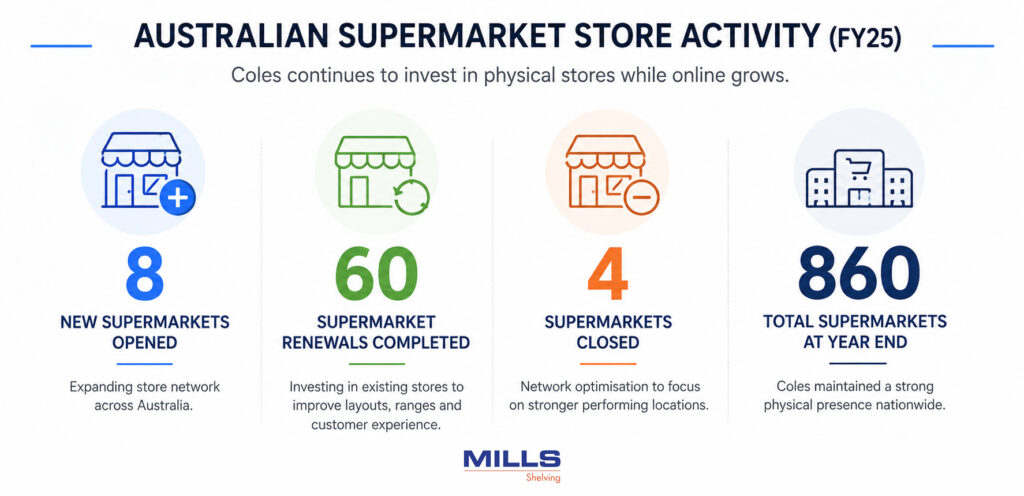
Online grocery may be growing, but Australia’s supermarket groups are not retreating from physical retail.
Coles provides a clear example. During FY25, the retailer:
Store renewal is particularly relevant. A supermarket does not need to be a new development for substantial capital to flow into its physical environment.
Existing stores are regularly reworked as ranges change, technology is added, fulfilment requirements evolve, and retailers look for better use of available floor space.
For grocery operators, that puts more pressure on fixtures to remain adaptable. A shelving configuration that suits the opening product mix may need to accommodate new categories, promotional allocations, private-label expansion or different pack sizes several years later.
This is one reason the specification of grocery store shelving is part of the broader store-planning decision rather than simply a choice of fixture. Shelf capacity, bay configuration, product visibility and the ability to adjust layouts all affect how efficiently a grocery retailer can use its selling space.
From Mills Shelving’s experience working with Australian retailers, the practical requirement is rarely just to fit the maximum number of shelves into a store. The configuration also needs to account for how stock is replenished, how customers move through aisles, which categories require stronger visibility and where the retailer needs flexibility to change the range.
The clearest change in grocery behaviour is not that Australians have stopped spending. It is that they are becoming more deliberate about how they spend.
Price comparisons, specials, private-label alternatives and switching between retailers all become more important when household budgets are under pressure. The Australian Retail Council’s 2026 commentary points to consumers remaining highly value-conscious even while retail expenditure continues to grow.
That behaviour is visible in the supermarket itself. A shopper may still buy roughly the same categories each week but change brands, delay discretionary items, buy on promotion or choose a cheaper substitute.
The result is a grocery basket that is more fluid than headline sales growth might suggest.
It also gives promotions greater influence over decisions made inside the store. Circana’s Australian FMCG analysis found that promotional activity had reached record levels, while 45% of shoppers were actively seeking promotions, an increase of 16 percentage points from 2022.
For retailers and suppliers, that changes the role of merchandising. A promotion has limited value if shoppers cannot quickly identify the product, understand the offer or find it within the category.
Food inflation has eased from some of the sharper increases seen earlier in the decade, but grocery prices are still moving upwards.
ABS figures show food and non-alcoholic beverage prices increased 3.3% in the 12 months to June 2026. Food was one of the largest contributors to Australia’s annual CPI increase of 3.8%.
Price pressure also varies substantially by product. Meat, fruit and vegetables, dairy, eggs and packaged goods can move differently depending on supply conditions and input costs, which means shoppers experience grocery inflation differently depending on what they regularly buy.
The difference between supermarket chains can be significant as well.
CHOICE sent fieldworkers to 104 supermarkets across 27 Australian locations in March 2026 to compare grocery prices. For its standard eight-item basket without specials, Aldi averaged $31.46, compared with $37.45 at Woolworths, $38.48 at Coles and $46.23 at IGA.
The IGA result requires context because independent stores can set different prices, creating considerably more variation between locations. CHOICE specifically notes that local IGA prices may be closer to competing supermarkets than its national average suggests.
The wider point is more useful than declaring one retailer universally cheapest: Australian shoppers can save meaningful amounts depending on where they shop, which products they choose and whether those products are on promotion.
That is making value a much broader competitive issue than the price of an individual item.
The search for value has made promotions more influential in the grocery aisle.
Circana reports that the share of grocery units sold on promotion in Australia has reached record levels. At the same time, 45% of shoppers actively seek promotions, up 16 percentage points from 2022.
That behaviour can change the contents of a basket after a shopper enters the store. Circana found that three-quarters of shoppers make unplanned purchases after seeing a promotion.
This is where price and merchandising intersect. A discount may attract attention, but its effectiveness also depends on where the product is positioned, how clearly the offer is communicated and how easily shoppers can compare it with alternatives.
The ACCC’s Supermarkets Inquiry examined the complexity of supermarket promotional pricing in detail, including loyalty pricing, “was/now” promotions and other discount practices.
Its findings reinforce how important clear pricing information has become for shoppers trying to judge whether an offer represents genuine value.
Promotions are no longer just a short-term sales tool. In a price-sensitive market, they are increasingly part of how consumers plan their grocery spending.
Private label is another major part of the value equation.
Supermarket-owned products have traditionally competed heavily on price, but the distinction between private label and established national brands has become less straightforward. Retailers now use own-brand ranges across entry-level staples, mainstream products and higher-value categories.
Circana’s private-label research points to shoppers balancing affordability, quality and availability, rather than treating own-brand products purely as a last-resort substitute.
The research also shows branded products tend to depend more heavily on promotional activity than private-label ranges in markets including Australia.
This is not unique to Australia. NielsenIQ’s Asia-Pacific research, which includes Australia among the markets studied, found 54% of consumers said they were more likely to buy private-label products than ever before.
The regional figure should not be read as an Australian private-label penetration rate. It does, though, provide useful context for the same value-led behaviour visible in Australian grocery research.
NIQ’s broader consumer outlook for 2026 also identifies affordability and more deliberate spending as continuing influences on consumer packaged goods purchasing.
For supermarkets, greater private-label demand has consequences beyond procurement and pricing. Retailers have to decide how much shelf space their own ranges receive, how those products sit beside national brands and how different price tiers are presented within a category.
Shelf space, in other words, is part of the competitive strategy.
Australian grocery shopping is increasingly split between digital and physical channels rather than moving cleanly from one to the other.
Woolworths offers a useful measure of how established online grocery has become. In Q4 FY25, eCommerce represented 15.1% of Australian Food sales, supported by delivery, Direct to Boot and other fulfilment options.
Online is also contributing disproportionately to broader retail growth. Circana reported that eCommerce was contributing 45% of total Australian retail growth, alongside increasing demand for rapid-delivery shopping missions.
The important point is that digital growth does not automatically translate into declining relevance for supermarkets.
Deloitte Australia’s grocery research describes a more hybrid shopping environment, where consumers move between physical stores, online ordering, pick-up and delivery depending on the shopping mission.
A weekly stock-up may still happen in a supermarket. Forgotten ingredients might be ordered for rapid delivery. A customer may place an online order and collect it from the same store they previously shopped in person.
The store increasingly supports several shopping journeys at once.
That changes its operational role as well. Supermarkets may need to accommodate customers browsing aisles, staff picking online orders, replenishment activity and click-and-collect operations within the same footprint.
The continued investment in physical supermarkets makes more sense when viewed against that hybrid model.
Coles completed 60 supermarket renewals during FY25, alongside eight new openings.
The programme continued into FY26. In the first half alone, Coles completed 35 supermarket renewals and opened six new supermarkets.
These numbers are significant because renewals are not simply cosmetic refurbishments. Modern supermarket investment can involve changes to layouts, refrigeration, checkout areas, online fulfilment, product ranges, signage, fixtures and the allocation of selling space.
Investment is also extending well beyond the shop floor.
Coles has invested in automated distribution centres and customer fulfilment centres as part of a wider effort to improve supply-chain efficiency and support online grocery growth.
Woolworths is following the same broader direction, combining investment in its store network with eCommerce fulfilment and supply-chain infrastructure. Its FY25 reporting shows how physical stores, digital ordering and fulfilment capabilities increasingly operate as parts of the same retail system.
The supermarket of 2026 is still very much a physical business. What has changed is how much that physical network is expected to do.
Several of these market trends eventually meet in the same place: the supermarket aisle.
Value-conscious shoppers are looking harder at prices. Promotional purchases are increasing. Private-label products are competing for attention alongside established brands. Product ranges change, while stores are being renewed rather than remaining static for decades.
That puts more emphasis on how selling space is configured.
Circana’s finding that three-quarters of shoppers make an unplanned purchase after seeing a promotion is particularly relevant to physical merchandising.
Product visibility matters when retailers are trying to convert that behaviour into sales. So does the ability to change shelf allocations when a promotion begins, a new range launches or demand shifts between pack sizes and brands.
Private-label growth adds another consideration. More retailer-owned products can mean greater assortment complexity within categories as supermarkets decide how much space to give their own ranges relative to national brands.
From a store-planning perspective, this favours shelving and fixtures that can be adjusted rather than layouts designed around a fixed product mix.
“Grocery ranges don’t stay the same for long. Promotions change, pack sizes change, and retailers introduce new products, so the shelving needs to give the store room to adapt. A good layout should work for the range you have today without making the next change unnecessarily difficult.”
Neil Webster, CEO, Mills Shelving
For Mills Shelving, the practical issue is usable capacity rather than simply the number of shelves installed. Shelf depth, vertical spacing, bay widths and aisle configuration all influence how much stock can be presented without making categories difficult to shop or replenish.
That becomes particularly important during supermarket refurbishments. Retailers may be working within an existing footprint while trying to increase range, improve visibility and create space for new services or equipment.
The best use of floor space is not necessarily the layout that holds the most product. It is the one that balances capacity with access, visibility and movement.
Technology investment is taking place both behind the scenes and directly in front of shoppers.
KPMG’s Australian Retail Outlook 2026 identifies AI, predictive personalisation and omnichannel retail among the areas shaping the next phase of Australian retail. At the same time, its research stresses that physical stores continue to matter to the customer experience.
That combination is important for grocery.
Technology can improve forecasting, inventory management, fulfilment and personalisation without removing the need for an effective store. Instead, digital systems increasingly influence what happens inside it.
Deloitte Australia’s grocery research similarly points to automation, AI, retail media and stronger digital customer relationships as areas changing how grocery businesses operate and engage shoppers.
The result is a physical supermarket with more technology layered into it: digital price communication, self-service systems, fulfilment processes, data-driven promotions and increasingly sophisticated retail media.
Even the traditional supermarket display is becoming more digital.
Metcash reported in late 2025 that more than 500 digital screens were operating across its LocalEyes independent retail media network, with plans to reach 750 screens by the end of FY26.
This creates another layer to merchandising. Retailers are no longer working only with shelf position, ticketing, end caps and promotional displays.
Digital screens and retail media can influence the shopper at different points in the store while creating a new advertising channel for suppliers.
Technology is also changing product discovery outside the supermarket.
Circana has identified developments such as agentic AI and digital shelf optimisation as emerging considerations for grocery and FMCG businesses.
That raises an interesting challenge for retailers and brands: products increasingly need to be discoverable in two environments at once.
One is the physical shelf, where position, range, availability and presentation matter.
The other is the digital shelf, where search, recommendations, availability data, personalisation and algorithms can influence which products a shopper sees first.
Neither can be treated in isolation.
The Australian grocery market in 2026 is not moving in a single direction.
Sales are growing, but shoppers remain careful with money. Food prices are still rising, yet consumers have more ways to compare value. Private label is gaining influence while national brands compete heavily through promotions. Online grocery is expanding, but supermarket groups continue to open and renew physical stores.
The clearest themes are:
The growth outlook remains positive. Circana forecasts 2.5% growth in food and beverage unit sales across Australia and New Zealand in 2026, with value growth above 6%.
Capturing that growth is becoming more complicated.
For Australian grocery retailers, the opportunity is not simply to sell more products. It is to make better use of the store, respond faster to changes in what customers buy and connect physical retail with the digital systems now shaping grocery shopping.
The statistics suggest that the supermarket is not disappearing. It is being asked to become more flexible, more efficient and more responsive to the way Australians now shop.