Commercial shelving plays an important role in how products are displayed, how customers navigate a store, and how efficiently retail space is used.
As Australian retailers face rising costs, changing consumer expectations and growing competition from ecommerce, many are focusing on improving existing store layouts rather than expanding floor space.
The statistics below examine the latest trends shaping commercial shelving in Australia, including retail growth, store expansion, shelf space optimisation, merchandising, customer behaviour and retail technology.
Australia’s retail sector remains one of the country’s largest industries, creating ongoing demand for commercial shelving across supermarkets, convenience stores, pharmacies, hardware retailers, discount stores and grocery stores.
Although online shopping continues to grow, physical stores remain the primary channel through which Australians purchase everyday goods.
That means investment in shelving, store layouts and merchandising continues to play an important role in retail performance.
The Australian Bureau of Statistics reported continued growth across several retail categories before the Retail Trade publication concluded in mid-2025, including a 1.2% monthly increase in supermarket and grocery store turnover during June 2025. This reflected stronger consumer spending on essential goods despite ongoing economic pressures.
That matters because supermarkets are among Australia’s most shelving-intensive retail environments.
Every increase in product range, inventory volume or customer traffic creates greater demand for efficient gondola shelving, end bays, promotional displays and stock management systems.
Following the retirement of the Retail Trade series, the ABS introduced the Monthly Household Spending Indicator, providing a broader measure of Australian household expenditure across both goods and services.
The data continues to show that essential retail categories remain relatively resilient compared with discretionary spending, reinforcing ongoing investment in grocery, pharmacy and household retail formats.
Industry-wide indicators tell a similar story.
According to the Australian Retail Council, Australia’s retail industry contributes approximately $444 billion to the economy, employs more than 1.4 million Australians, and continues adapting to changing consumer behaviour through both physical and digital channels.
The organisation also reports that 9.8 million Australian households now shop online, with 41% purchasing online at least every fortnight.
Rather than reducing the importance of physical stores, these figures highlight why retailers increasingly focus on improving the in-store experience.
Physical stores now need to offer something ecommerce cannot, including better product discovery, intuitive store navigation and well-presented merchandise.
From our experience at Mills Shelving, retailers are increasingly approaching shelving as a long-term operational investment rather than simply purchasing fixtures.
Businesses planning new stores or refurbishments often evaluate shelving based on flexibility, durability, merchandising capability and future expansion rather than upfront price alone. Those considering a new fit-out can explore our range of commercial shelving systems to understand how modular shelving supports different retail environments.
Retail sales provide only part of the picture. Demand for commercial shelving is also driven by the number of stores being built, refurbished and expanded each year.
Australia’s largest retailers continue investing heavily in their physical networks, demonstrating ongoing confidence in bricks-and-mortar retail despite rapid digital growth.
Coles provides one of the clearest examples.
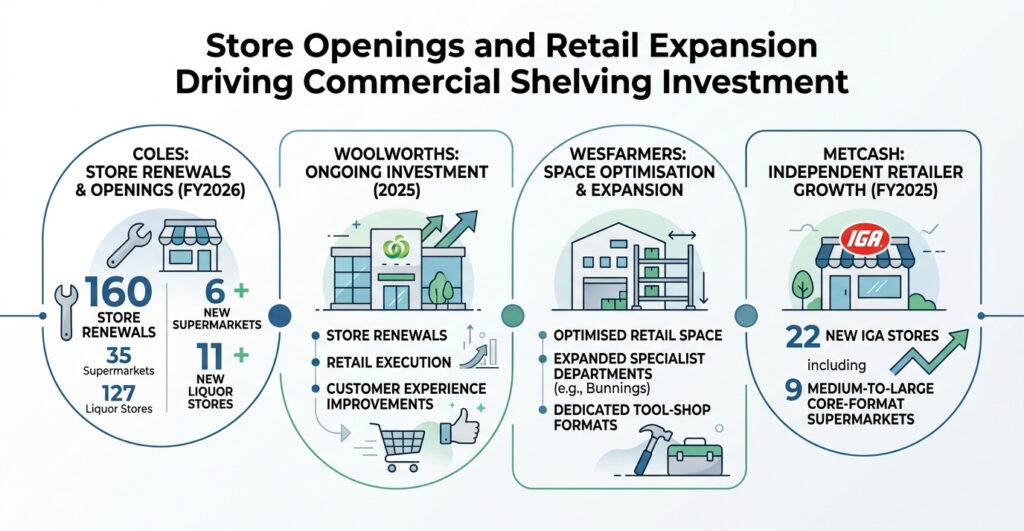
During the first half of FY2026, the company completed approximately 160 store renewals, including 35 supermarkets and 127 liquor stores, while opening six new supermarkets and 11 new liquor stores.
Each renewal represents far more than cosmetic improvements. Store refurbishments typically involve replacing shelving systems, updating merchandising layouts, improving aisle navigation and creating additional promotional display areas.
Woolworths continues to follow a similar strategy.
Its 2025 Annual Report outlines ongoing investment across supermarkets, Metro stores and BIG W, alongside continued capital expenditure supporting store renewals, retail execution and customer experience improvements.
The message is clear: Australia’s largest retailers continue investing in physical stores because merchandising, product availability and customer experience remain competitive advantages.
The same trend extends beyond supermarkets.
Wesfarmers reported continued optimisation of retail space throughout Bunnings while expanding specialist departments and introducing dedicated tool-shop formats across its store network.
These changes demonstrate how commercial shelving evolves alongside changing product ranges and customer demand rather than remaining static over a store’s lifetime.
Independent retailers are investing too.
Metcash’s FY2025 Annual Report recorded 22 new IGA stores, including nine medium-to-large core-format supermarkets, highlighting continued expansion across independently owned grocery retailers.
Taken together, these figures demonstrate that demand for commercial shelving is supported by multiple drivers:
For shelving suppliers, growth comes not only from new retail developments but also from retailers continually adapting existing stores to changing consumer expectations.
Retail floor space has become an increasingly valuable asset.
Construction costs remain elevated, prime retail locations continue attracting investment, and shopping-centre vacancy remains relatively low across many markets. As a result, retailers are under greater pressure to maximise sales from the space they already occupy.
CBRE reported that Australian shopping centres attracted $6.8 billion in investment during 2025, reflecting continued confidence in retail property despite broader economic uncertainty.
For retailers, this confidence translates into continued investment in tenancy upgrades, store refurbishments and modern retail fit-outs.
JLL’s Australian Retail Market Dynamics research also identified declining vacancy across many retail property sectors alongside gradually improving rental performance.
As available retail space becomes more valuable, businesses increasingly focus on improving sales productivity within existing store footprints rather than relying solely on expansion.
Regional shopping centres face similar conditions.
The Property Council of Australia reported that vacancy across regional shopping centres remained around 2.7%, while construction activity continued to slow as development costs increased.
These conditions reinforce a broader shift across Australian retail.
Rather than asking, “How can we build a bigger store?”, retailers increasingly ask, “How can we make our current store perform better?”
Commercial shelving sits at the centre of that discussion.
Well-designed shelving allows retailers to increase product capacity, improve stock accessibility, optimise customer flow and create more effective promotional space without increasing their overall footprint.
For businesses evaluating new fixtures or refurbishment projects, understanding the total investment is equally important.
Our guide explaining how much commercial shelving costs outlines the key factors that influence pricing, from store size and shelving configuration to accessories and installation requirements.
As retail space becomes more valuable, the focus naturally shifts towards making every shelf work harder.
Retailers no longer evaluate shelving purely on storage capacity. Instead, they increasingly measure how effectively each fixture supports product visibility, replenishment efficiency, category management and overall sales performance.
The Australian Competition and Consumer Commission’s Supermarkets Inquiry highlights just how commercially valuable shelf space has become.
Its investigation found that product ranging, promotional positioning and shelf allocation form an important part of competition between suppliers seeking access to Australia’s major supermarket chains.
Shelf placement influences which products shoppers see first, how easily brands are discovered and the promotional opportunities available throughout the store.
This has practical implications beyond supermarkets.
Whether operating a pharmacy, convenience store, hardware retailer or independent grocery store, businesses increasingly rely on shelving systems that support:
Modern commercial shelving has become an operational tool as much as a physical fixture, helping retailers balance merchandising objectives with day-to-day efficiency.
As customer expectations continue evolving, the conversation extends beyond simply allocating shelf space.
The next challenge is ensuring products are displayed in ways that attract attention, encourage browsing and ultimately influence purchasing decisions.
Allocating shelf space is only part of effective merchandising. The way products are presented within that space can significantly influence how customers interact with a store.
Retailers have long recognised that product visibility affects purchasing decisions, but modern merchandising goes beyond simply placing products at eye level.
Store layouts, category flow, promotional displays and signage all contribute to how easily shoppers discover products and move through the retail environment.
Consumer behaviour is also changing.
The Commonwealth Bank Consumer Insights Report found that 90% of Australians are actively looking for ways to save money, 73% use promotions or loyalty rewards, and 66% spend more time researching purchases before buying.
These figures suggest shoppers are becoming more deliberate in how they purchase products. For retailers, that places greater emphasis on clearly organised shelving, visible promotional displays and merchandising that helps customers compare products quickly.
Global research from NielsenIQ points to similar trends.
Consumers continue placing greater importance on value, trusted brands and price transparency, while becoming increasingly selective about discretionary purchases. As purchasing decisions become more considered, physical stores need to make product discovery as simple as possible.
Academic research also reinforces the importance of shelf positioning.
A 2025 eye-tracking study comparing shopper behaviour across supermarket shelving found that visual attention varies considerably across different shelf levels and product locations. Rather than distributing attention evenly, shoppers naturally focus on particular areas of a shelving bay depending on their shopping objective and surrounding product placement.
This highlights an important point.
There is no universal “perfect shelf.” Premium products, promotional items, everyday essentials and impulse purchases often perform differently depending on category, customer intent and store layout.
Store navigation plays an equally important role.
Research analysing more than 23,000 shopper trajectories demonstrated clear relationships between customer movement, shelf browsing behaviour and purchasing activity.
The study showed that the way customers travel through a store directly affects which products they encounter and how long they engage with different categories.
For retailers, effective merchandising is rarely achieved through a single display or promotional campaign.
Instead, it results from multiple elements working together:
From our experience, retailers often achieve meaningful improvements through relatively small layout adjustments.
Repositioning key categories, improving aisle consistency or creating additional promotional display space can improve the shopping experience without requiring a complete store refit.
Commercial shelving is also becoming more data-driven.
Retailers are increasingly combining traditional merchandising principles with technology that helps monitor product availability, improve planogram compliance and optimise shelf layouts.
One area seeing rapid development is computer vision.
Researchers have demonstrated systems capable of automatically comparing live shelf conditions against planned layouts, identifying missing products, incorrect product placement and merchandising inconsistencies without relying solely on manual store audits.
For large retailers operating hundreds of stores, this technology has the potential to improve merchandising consistency while reducing the time staff spend checking planogram compliance.
Artificial intelligence is beginning to influence merchandising in other ways as well.
Recent research has shown how AI can generate store-specific planograms by considering store size, customer demand and product assortment rather than applying a single layout across an entire retail network.
Although many of these technologies remain in the early stages of adoption, the broader direction is clear.
Retailers are increasingly making merchandising decisions using data rather than intuition alone.
That does not reduce the importance of physical shelving. In fact, it reinforces it.
The most advanced merchandising software still relies on shelving systems that are flexible enough to accommodate changing product ranges, promotional campaigns and evolving customer behaviour.
Modular shelving makes these adjustments significantly easier than fixed retail fixtures, allowing layouts to evolve without major refurbishment costs.
Predictions about the decline of physical retail have circulated for many years.
The data suggests a different reality.
Online shopping continues growing, but physical stores remain central to how Australians purchase groceries, household goods, hardware, pharmacy products and many discretionary items.
According to NAB’s Online Retail Sales Index, Australians spent approximately $66.23 billion online during the 12 months to September 2025, representing around 14.9% of total retail spending.
While significant, those figures also indicate that the majority of retail expenditure still occurs outside pure ecommerce.
That reality continues shaping investment priorities.
Rather than competing with online retailers solely on price, physical stores increasingly differentiate themselves through:
Commercial shelving plays a practical role in each of these areas.
Well-designed shelving helps customers find products quickly, supports attractive merchandising, improves stock availability and creates a more organised retail environment.
As digital and physical retail become increasingly interconnected, store fixtures are evolving from static infrastructure into adaptable merchandising platforms that support omnichannel retail strategies.
The data throughout this article point towards a consistent conclusion.
Australian retailers continue investing in physical stores.
Major supermarket groups are opening new locations and refurbishing existing ones. Independent retailers continue expanding. Shopping-centre investment remains strong, while retail space itself is becoming increasingly valuable.
At the same time, consumer expectations are changing.
Shoppers expect stores that are easy to navigate, well organised and visually engaging. Retailers are responding by placing greater emphasis on merchandising, category management and efficient use of every square metre.
Technology is accelerating that shift.
Planogram software, AI-assisted merchandising and computer vision are helping retailers make more informed decisions about product placement and shelf management. These tools complement effective shelving systems rather than replacing them.
For businesses planning a new store, refurbishment or retail expansion, commercial shelving should be viewed as long-term operational infrastructure rather than a one-off fixture purchase.
The right shelving system supports:
If you’re evaluating shelving for a new retail project, our range of commercial shelving has been designed to support supermarkets, convenience stores, hardware retailers, pharmacies and specialty retail environments across Australia.
As Australia’s retail landscape continues evolving, one trend remains consistent.
Retailers that make better use of their available space are likely to be better positioned to improve product visibility, merchandising performance and customer experience. Commercial shelving may sit quietly in the background of every store, but the statistics show it remains one of the foundations of successful physical retail.
At Mills Shelving, we supply commercial shelving built for Australian retail environments.
Our modular commercial shelving systems help retailers maximise floor space, improve product presentation and create stores that are practical, efficient and built for long-term performance.
If you’re opening a new store, refurbishing an existing space or expanding your retail footprint, our team provides quality shelving, expert advice and Australia-wide delivery to help bring your project to life.