Retail in Australia is not slowing down. It is changing shape.
Household spending reached $78.98 billion in January 2026, increasing 0.3% month-on-month and 4.6% year-on-year. That level of growth signals resilience, even as financial pressure continues to build across households.
At the same time, inflation remains elevated at 3.8% year-on-year, with housing, food, and recreation driving the increase. These are not discretionary categories. They sit at the core of everyday spending, which means consumers are feeling the pressure before they even reach retail.
The result is a market that looks healthy on the surface but behaves differently underneath. Spending is holding up, yet the way Australians choose where and how to spend has shifted.
Confidence is not keeping pace with spending.
The Roy Morgan index shows consumer confidence dropped to 68.5 in March 2026, with only 15% of Australians saying they are financially better off than a year ago. The Westpac sentiment index tells a similar story, falling to 92.9 and reflecting hesitation around major purchases.
Despite this, money is still moving.
Consumer spending rose 0.5% month-on-month and 6.6% year-on-year in January 2026, with growth concentrated in personal and household goods. In parallel, household spending volumes increased 2.2% quarter-on-quarter and 2.4% year-on-year.
That contrast matters.
Retail insolvencies rising 23% in 2025 reinforce the imbalance. Consumers are still buying, but not every business is capturing that demand.
The takeaway is straightforward. Growth exists, but it is uneven and harder to access.
Retail performance reflects that same tension between demand and pressure.
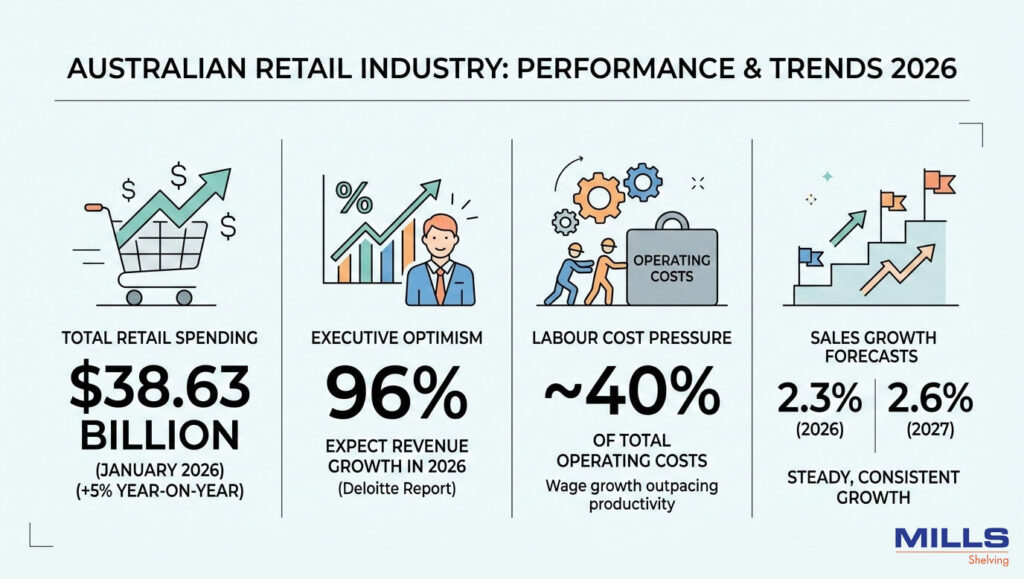
Total retail spending reached $38.63 billion in January 2026, up 5% year-on-year, with strong growth across food services, clothing, and specialty retail. Earlier data from October 2025 showed a similar trajectory, with spending at $38.5 billion, rising 5.7% year-on-year.
Growth is consistent. It is not explosive.
Forecasts suggest retail sales will increase 2.3% in 2026 and 2.6% in 2027 as real wages improve and consumer confidence stabilises. That points to a steady recovery rather than a rapid expansion.
From an operational perspective, retailers are optimistic. Deloitte reports that 96% of retail executives expect revenue growth in 2026, while 81% anticipate margin expansion.
Yet the cost side is tightening.
Labour now accounts for around 40% of operating costs, and wage growth continues to outpace productivity, which sits at roughly 1.1%. That gap puts pressure on margins, especially for businesses with large physical footprints.
For retailers operating stores, every square metre matters more than it did a few years ago. Layout, flow, and product visibility directly influence conversion. It is one of the reasons more businesses are revisiting how they structure their spaces, using practical approaches like improving merchandising and traffic flow through better store design.
For those exploring this area, it is worth reviewing how to create an inviting retail store layout to understand how small changes in layout can influence customer behaviour and sales outcomes.
Australian consumers are not spending less. They are spending differently.
Price sensitivity is now dominant. Around 86% of consumers prioritise price when making purchasing decisions, while 48.2% are focused primarily on essential spending.
That shift is reinforced by broader sentiment data:
These are everyday expenses. When they rise, discretionary spending becomes more selective.
Behaviour follows quickly. Around 75% of Australians now identify as bargain hunters, actively switching brands for better value. Two-thirds describe themselves as careful with money.
This is not a temporary adjustment.
Deloitte reports that about 70% of retail leaders believe value-seeking behaviour is now a structural shift rather than a short-term response to inflation.
At the same time, price is not the only factor.
Roughly 40% of a brand’s perceived value now comes from non-price elements such as convenience, service, loyalty programs, and checkout experience.
Consumers want value, but they define it more broadly.
McKinsey’s research adds another layer. Australian consumers remain cautious, yet they are still willing to spend on essentials. Lower-income households are showing a higher willingness to splurge compared to middle-income groups, and shoppers continue to experiment with new brands.
That combination creates a more complex customer:
Retailers who rely purely on discounting will struggle. Those who combine pricing with experience, availability, and convenience are better positioned to capture demand.
From a physical retail perspective, this shift also places more importance on how products are presented in-store. Clear visibility, logical grouping, and easy navigation are no longer optional. They directly support decision-making at the shelf level, particularly in high-volume environments such as supermarkets and large-format stores.
Ecommerce continues to grow, but it is not replacing physical retail. It is reshaping it.
Online retail sales reached $4.70 billion in June 2025, increasing 13% year-on-year and 3.9% month-on-month. That level of growth confirms sustained demand, even as conditions tighten.
Over a longer horizon, ecommerce’s share of total retail has increased from 9.9% in 2020–21 to 11.8% in 2024–25, with total retail revenue expected to reach $271.3 billion. The shift is steady rather than dramatic, which is important. It signals evolution, not disruption.
Australia Post data reinforces the scale. Ecommerce spending reached $82.6 billion in 2025, growing 14% year-on-year and accounting for 24% of total retail activity. Quarterly data shows the same pattern, with spending up 15% year-on-year in Q3 2025 and 8.1 million households actively shopping online.
Adoption is widespread. Around 9.8 million Australian households shopped online in 2025, with 41% purchasing at least every two weeks.
Yet physical retail remains dominant.
Around 7 million Australians now buy groceries online, but most shopping journeys still involve visiting a physical store. Nearly three-quarters of FMCG sales still occur offline, with significantly higher household spending taking place in-store.
The takeaway is clear. Retail is no longer online versus offline. It is both.
Customers browse online, compare prices, visit stores, and return to digital channels. The journey is blended. For retailers, this means:
For physical retailers, this increases the importance of in-store execution. Layout, accessibility, and product placement play a direct role in converting traffic that may have originated online. Businesses investing in structured systems such as retail shelving solutions are better positioned to present products clearly and maximise space efficiency, particularly in competitive environments.
Large platforms are changing how Australians discover and buy products.
Nine in ten Australian households now shop on major ecommerce platforms such as Amazon, Temu, and Shein, with average annual spending around $1,600. That level of penetration shifts competitive dynamics. Retailers are no longer competing only with local stores. They are competing with global platforms offering scale, pricing, and convenience.
Amazon’s trajectory reinforces this. It is projected to capture 20% of Australia’s online retail market by 2030. That kind of market share introduces sustained pressure on pricing and fulfilment expectations.
At the same time, customer expectations are rising.
Around three-quarters of consumers expect personalised shopping experiences, while 60% feel frustrated when offers are not relevant. Relevance is no longer a competitive advantage. It is expected.
The path to purchase has also become fragmented. Consumers now move across search engines, social platforms, messaging apps, and physical stores before making decisions.
That shift creates two challenges:
Retailers need to be present across multiple touchpoints while maintaining a consistent experience. It is no longer enough to rely on a single channel or strategy.
Despite pressure, major Australian retailers are performing strongly.
Woolworths reported $69.1 billion in annual sales and $9.1 billion in ecommerce revenue in FY2025, highlighting the scale of both physical and digital operations. Coles delivered $23.62 billion in half-year revenue in 2026, with ecommerce sales growing 27%, showing how quickly digital channels are expanding within traditional retail.
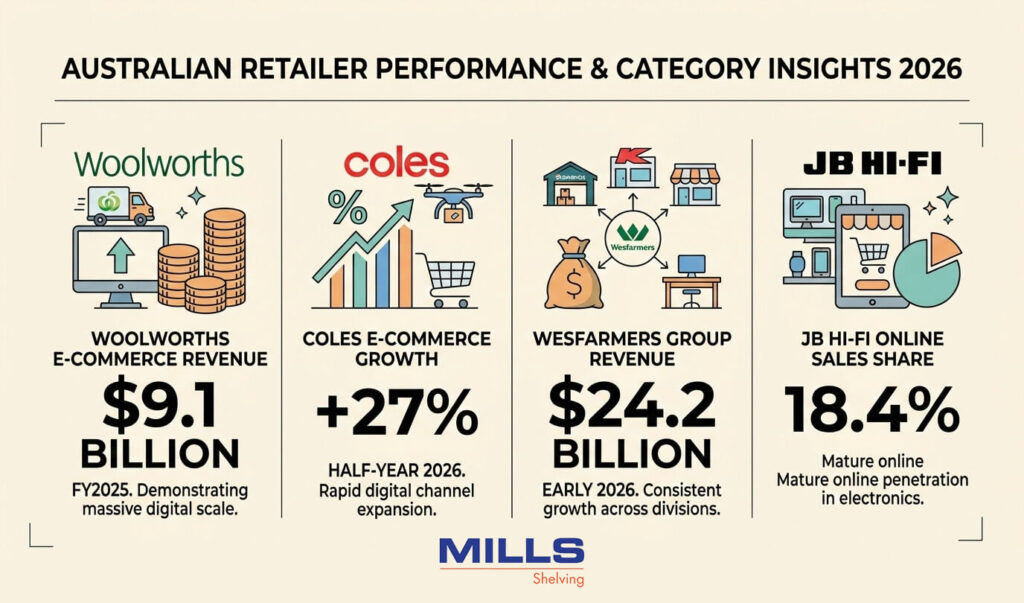
Wesfarmers generated $24.2 billion in revenue in early 2026, with steady growth across Bunnings, Kmart, and Officeworks divisions. JB Hi-Fi reported $6.1 billion in sales, up 7.3%, with online sales accounting for 18.4% of total revenue.
These results show a consistent pattern:
High-volume environments such as supermarkets and large-format stores are leading this growth. In these settings, efficiency and product accessibility are critical. Systems such as supermarket shelving play a direct role in how products are displayed, replenished, and purchased, particularly when dealing with high traffic and large product ranges.
Retailers that optimise both digital and physical execution are seeing the strongest results.
The data points to a clear conclusion. Growth is still available, but it is more competitive and more complex to capture.
Consumers are spending, but they are more selective. They expect value, but not only in price. They move across channels, compare options, and switch brands quickly. At the same time, operating costs are rising, and margins are under pressure.
Retailers need to respond on multiple fronts.
Pricing remains important, but it is no longer enough on its own. Experience, convenience, and clarity now influence purchasing decisions just as much. This applies both online and in-store.
From a physical retail perspective, every decision around space matters. Layout, shelving, and product visibility directly affect how customers navigate and buy. Businesses reviewing store performance often look at both design and infrastructure, including understanding how much it costs to install retail shelving in Australia when planning upgrades or new store fit-outs.
Execution is what separates growth from stagnation.
Retailers who align pricing, experience, and channel strategy will continue to capture demand. Those who rely on outdated models or inconsistent execution will struggle, even in a growing market.
2026 is not defined by a lack of opportunity. It is defined by how well businesses adapt to a more deliberate and informed customer.